

Selim Caravanserai
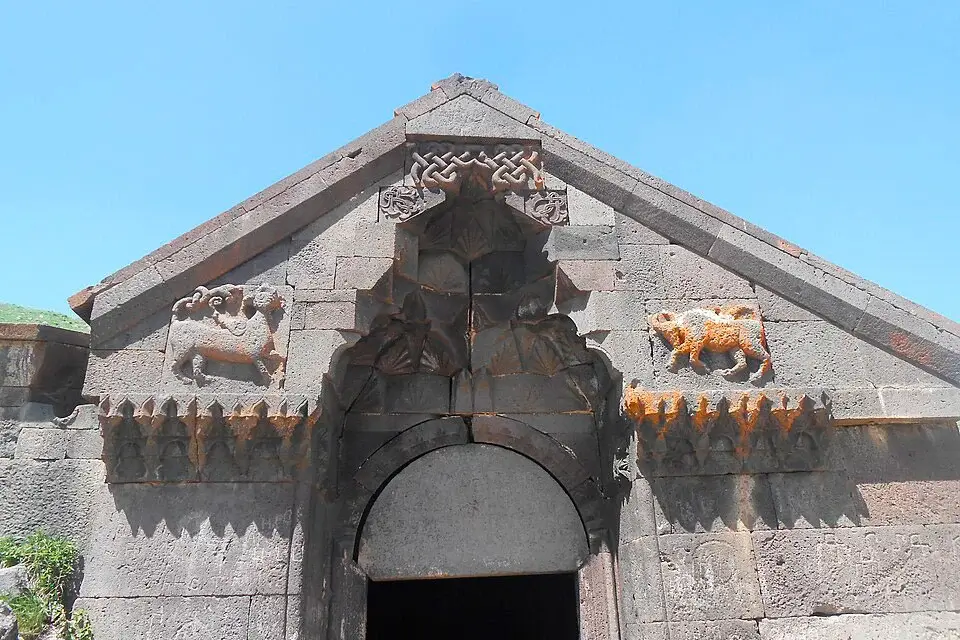
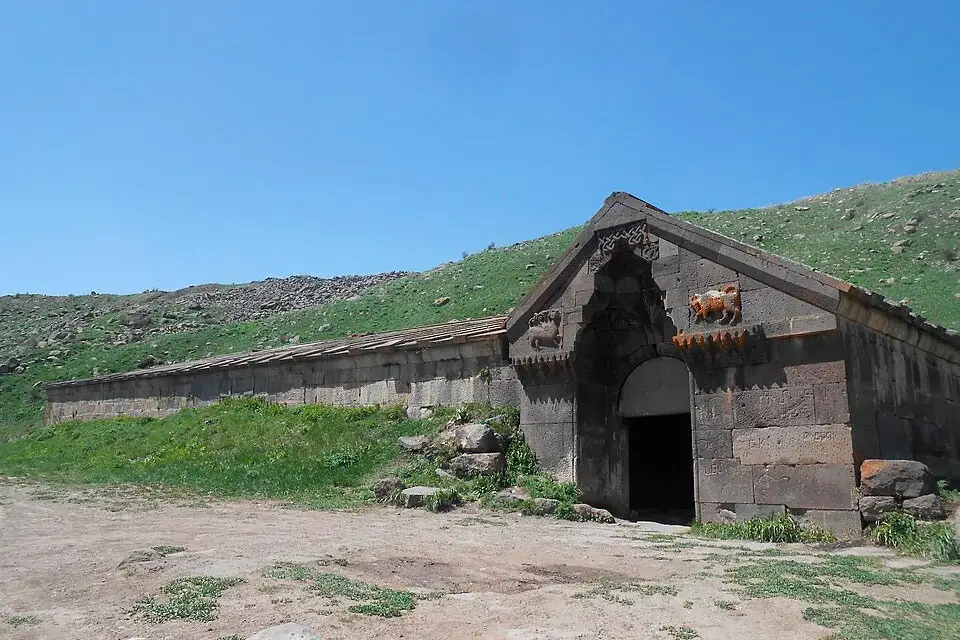
The Selim Caravanserai — officially renamed Orbelian’s Caravanserai in 2014 — is the best-preserved medieval caravanserai in Armenia. It stands at 2,410 metres on the Vardenyats Pass between the Lake Sevan basin and the Vayots Dzor valley, built almost 700 years ago by Prince Chesar Orbelian and his brothers as a sanctuary for travellers crossing the Silk Road. A vaulted basalt hall, two inscriptions over the entrance, a lion and a bull carved on the façade, and a panorama of two mountain ranges from the door — for many travellers it’s the single most atmospheric stop on the road south from Yerevan.
Quick Facts
- Built / Founded: 1326–1332 (Prince Chesar Orbelian and brothers)
- Location: Vardenyats Mountain Pass (formerly Selim Pass), Vayots Dzor Province
- Also known as: Orbelian's Caravanserai, Orbelyan Caravanserai, Sulema Caravanserai, Selim Caravansaray, Իջևանատուն, Օրբելյանների քարավանատուն
- From Yerevan: 130 km / 2–2.5 hours
- Elevation: 2410 m
- Entrance fee: Free, 24/7 (in season)
- Time needed: 20–40 minutes on site; pairs with Sevan → Noravank day loop
- Best time to visit: May–October (pass closed in winter)
- Status: Architectural monument; best-preserved caravanserai in Armenia
- GPS coordinates:
39.9495725, 45.2358842
A Note on the Names
You’ll see this site under at least three different names in guidebooks, maps and tour itineraries. They all refer to the same building.
In 2014, the governor of Vayots Dzor Province officially renamed the site Orbelian’s Caravanserai and the mountain pass it sits on Vardenyats Pass. The reason given was that “Selim” was understood to be the name of a foreign invader rather than a local place name, and the regional administration preferred to honour the Armenian princely family that actually built the monument. The old name has stuck in tourist literature, road signs, and most online maps, so today both names are used — sometimes interchangeably, sometimes side by side. Sulema Caravanserai is an older variant of the same name. In this guide we use “Selim Caravanserai” because that’s still the term most travellers search for.
Why Selim Caravanserai Matters
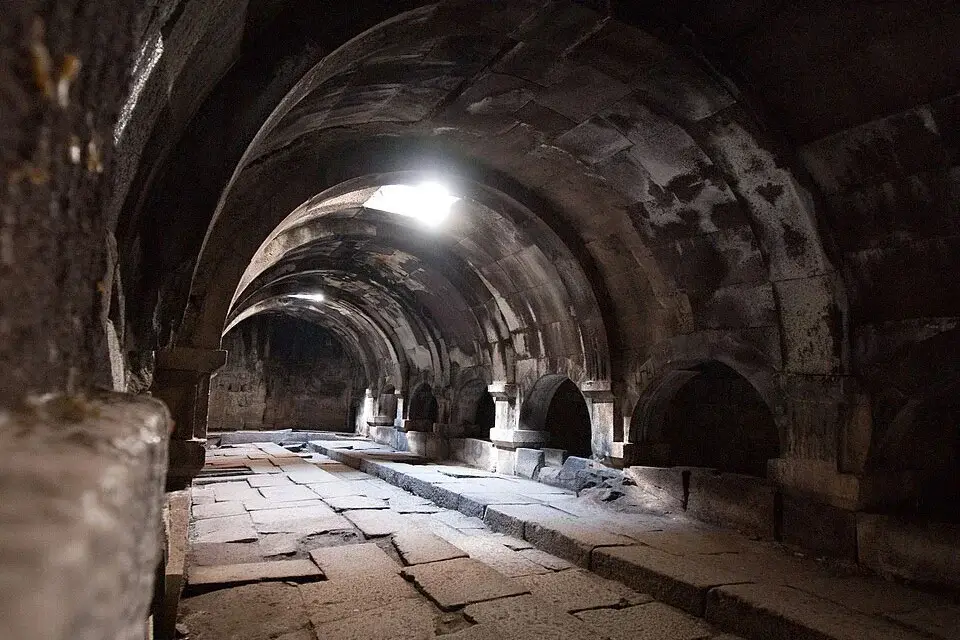
This is the best-preserved medieval caravanserai in the country — and one of the very few Silk Road inns anywhere in the South Caucasus that you can walk into and see almost exactly as it was built in the 14th century. The basalt walls are original, the vaulted roof is intact, the stone mangers between the pillars where the animals stood are still in place, and the inscription naming Prince Chesar Orbelian and his brothers is still legible above the door.
Beyond the building itself, the location is half the experience. The Vardenyats Pass is the dividing line between the Lake Sevan watershed and the Arpa River valley — what flows north reaches Sevan, what flows south reaches the Araks. The road over it is one of the most scenic in the country, and the caravanserai sits directly on it.
History — Built by the Orbelians in 1332
The Orbelians were one of medieval Armenia’s most powerful princely families, though their story actually begins in Georgia: they were exiled in the 12th century after a failed revolt against King Giorgi III. They settled in Armenia and, through a combination of diplomacy and survival, rose to govern the Kingdom of Syunik under the Mongol Ilkhanids in the 13th and 14th centuries. By the early 1300s the family was at its peak — Christian princes operating with effective autonomy under the Muslim Ilkhanate, mediating trade between Persia, Anatolia and the Caucasus.
Construction of the caravanserai began in 1326–1327 and was completed in 1332 at the order of Prince Chesar, son of Liparit Orbelian, with his brothers Burtel, Smbat and Elikum. Burtel is the same patron who commissioned the spectacular Burtelashen church at Noravank Monastery a generation later — the two monuments are part of the same dynastic building programme.
The building was a working inn on the international trade route that connected Dvin and Partav (and through them Persia, Anatolia and the Black Sea) for about 150 years. It was destroyed in the 15th–16th centuries, most likely during the campaigns of Timur and the wars that followed, and stood in ruins for four centuries. Soviet restorers rebuilt it between 1956 and 1959, and a further excavation in 2011 uncovered the original entrance between the vestibule and the main hall.
What You’ll See — Architecture
Selim Caravanserai is a textbook example of the single-hall Armenian caravanserai: one long basalt building, 37 metres from end to end, oriented east–west. Unlike Anatolian caravanserais of the same period — such as Karatay Han or Sultan Han in central Turkey — it has no open courtyard. Everything is under one roof. The building has three main parts.
The vestibule at the western end is the most ornamented section, with a half-rounded lintel above the doorway, a six-tier muqarnas vault, and the carved façade decoration that survives best of all the original details.
The main hall behind it is 13 × 26 metres, divided into three aisles by two rows of seven stone pillars. The central nave was for travellers; the two side aisles, with stone troughs running between the pillars, were for the pack animals — horses, mules and camels. Light enters through three openings cut into the vaulted stone roof, which acted as windows, smoke vents and ventilation all at once.
The eastern end of the hall once held a small chapel, today half-destroyed. Above the lintel of the main door, two bas-reliefs flank the entrance — a winged lion on the left and a bull on the right — representing the Orbelian family arms.
The Inscriptions
Two carved inscriptions name the builders. The first, in Persian, sits on the lintel above the main door and is dated 1326–1327 — it has been damaged by vandals and is hard to read now. The second, in Armenian, is cut into the eastern interior wall of the vestibule, dated 1332, and remains fully legible.
The Armenian text reads, in part:
“In the name of the Almighty and powerful God, in the year 1332, in the world-rule of Busaid Khan, I, Chesar son of Prince of Princes Liparit … and my brothers, handsome as lions, the princes Burtel, Smbat and Elikum of the Orbelian Dynasty … built this spiritual house with our own funds for the salvation of our souls … We beseech you, passers-by, remember us in Christ.”
“Busaid Khan” is the Armenian rendering of Abu Sa’id Bahadur, the last great Mongol Ilkhan, who ruled Persia and most of the South Caucasus from Tabriz between 1316 and 1335.
Where Selim Caravanserai Sits
The site lies just below the southern crest of the Vardenyats Pass, at 2,410 metres above sea level, in Vayots Dzor Province. Coordinates 39.9495725, 45.2358842. The pass itself is 55 km long, running from Martuni on the southern shore of Lake Sevan to Yeghegnadzor in the Arpa valley — the historical short-cut between Sevan and southern Armenia.
The current road over the pass was effectively rebuilt in 2003 with funding from the Lincy Foundation, established by Armenian-American philanthropist Kirk Kerkorian. It’s now a fully paved mountain road in good condition for most of the year.
How to Get to Selim Caravanserai
By car or with a driver from Yerevan — about 130 km, or 2 to 2.5 hours, going north-east via Lake Sevan and Martuni, then climbing south over the pass. The caravanserai is impossible to miss: it sits right on the road, a few hundred metres below the summit on the south side. A parking lay-by is right next to it.
The most flexible way to handle the trip is a car with driver from Yerevan on the classic Sevan → Selim Caravanserai → Noravank loop, which is one of the best one-day routes in southern Armenia. The same loop works as a private day tour from Yerevan with a guide if you want the history explained on site. For an even simpler one-leg option, a Yerevan–Sevan transfer can be extended with a stop at the caravanserai for a small surcharge.
By public transport there is no direct option. Marshrutkas run from Yerevan to Yeghegnadzor and to Martuni, but the pass itself is served only by occasional intercity buses that don’t stop at the monument.
When to Visit
May to October is the realistic window. The pass is officially open year-round, but heavy snow can close it from late November through April, and even when it’s open in shoulder season the road is slow.
June to early September offers the most reliable weather, with daytime air around +18 to +22 °C at the pass and bright clear light for photography. September to mid-October is the most rewarding stretch — golden grass on the slopes, almost no other visitors, and the air still warm enough for a long stop outside.
A note that holds in every season: at 2,410 metres the wind is constant and the air is several degrees cooler than in Yerevan. A windbreaker or fleece is not optional, even on a hot summer day in the valley.
Sunset is the photographer’s hour here — the basalt façade picks up the warm light and the surrounding ridges turn red. If you can time the stop, it’s worth it.
What to See Nearby
- Lake Sevan — about 40 km north of the pass. Sevanavank Monastery on the northwestern shore is the natural sister stop on the route up.
- Noravank Monastery — about 50 km south, in a red-cliff canyon. Commissioned by the same Orbelian family. The two monuments are usually visited on the same day.
- Areni village — the wine route and the Areni-1 cave with the world’s oldest leather shoe and the earliest known winery. About 60 km south.
- Jermuk Waterfall and the spa town of Jermuk — about 60 km south-east.
- Smbataberd Fortress and Tsakhats Kar Monastery — medieval sites in the Yeghegis valley about 25 km south, for travellers with a free half-day.
The standard one-day loop from Yerevan is Sevan → Selim Caravanserai → Noravank → Areni → back, returning in the evening.
Practical Notes
- Entry is free, and the site has no gates — accessible 24 hours a day in season.
- Time on site: 20 to 40 minutes is normal. Compact but atmospheric.
- No facilities on site: no café, no toilets, no shop. The nearest are in Martuni (40 km north) or Yeghegnadzor (30 km south).
- Mobile signal is patchy at the pass. Download offline maps before you arrive.
- Bring water in summer — the dry mountain air at altitude is thirstier than it feels.
- Drone footage of the building against the pass is one of the most striking sequences you can shoot in Armenia. Check current drone rules before flying.


