

Haghartsin Monastery
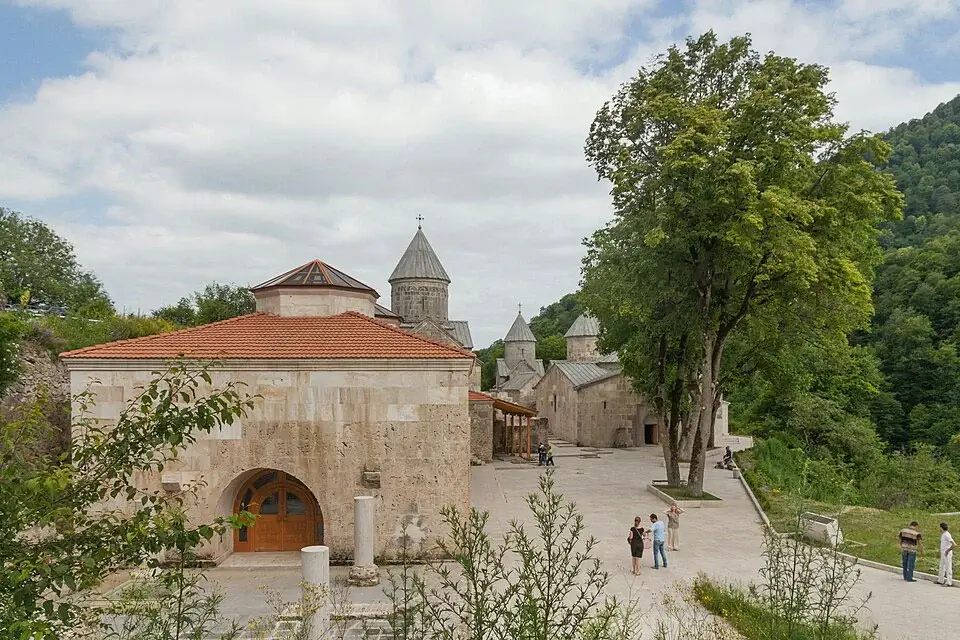
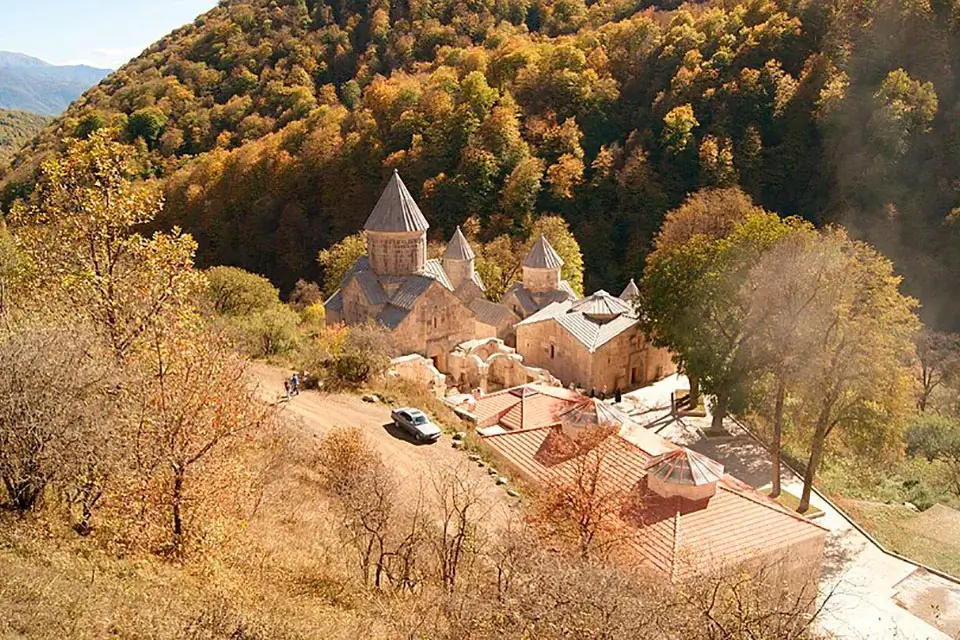
Haghartsin Monastery (Armenian: Հաղարծին — “the playing eagles”) is a medieval complex built between the 10th and 13th centuries deep in the forests of Dilijan National Park, about 110 km north of Yerevan. Three churches, a gavit, and a refectory stand on a wooded clearing surrounded by beech and oak ranges in the Tavush Province. Legend says the name comes from eagles seen playing above the dome during the consecration of one of the churches. Haghartsin is one of the rare Armenian monasteries where architecture and forest read as a single composition — and it is usually paired with Goshavank Monastery, the other jewel of Tavush, just 20 km southeast.
Quick Facts
- Built / Founded: 10th–13th centuries
- Location: Dilijan, Tavush Province
- Also known as: Haghartsin Monastery, Հաղարծին, Haghardzin
- From Yerevan: 110 km from Yerevan
- Entrance fee: Free
- Time needed: 1–1.5 hours
- Best time to visit: May–October; late September–mid-October for autumn foliage
- Status: Active (Armenian Apostolic Church)
- GPS coordinates:
40.802004, 44.890598
History: from Bagratuni patronage to the Sharjah restoration
The earliest building at Haghartsin — the small Church of St. Gregory — was raised at the turn of the 10th–11th centuries under the patronage of the Bagratuni dynasty. The monastery quickly developed into a religious and educational hub, with a scriptorium where monks copied manuscripts and a school of liturgical music. The 13th-century historian Kirakos Gandzaketsi credits the poet-musician Khachatur of Taron, abbot in the late 12th century, with the monastery’s revival after the Seljuk raids and with the creation of a new system of musical notation for Armenian worship.
The golden age came under the Zakarid princes (12th–13th centuries), when the gavit (1185), the Church of St. Stepanos (1244), the refectory (1248), and the main Church of St. Astvatsatsin (1281) were all built. Two members of the Kiurikid branch of the Bagratuni dynasty — likely Kings Smbat and Gagik — are believed to be buried in the partially preserved sepulchre next to St. Gregory’s Church.
After the Mongol and Timurid invasions of the 14th–15th centuries, the monastery fell into decline. By the 20th century the forest had partly swallowed the buildings. The major restoration ran from 2008 to 2013, funded by Sheikh Sultan bin Muhammad Al-Qasimi, ruler of Sharjah (UAE), who had visited Haghartsin in 2005 and was moved by its setting — an unusual case of a Muslim ruler financing the rebuilding of an Armenian Christian monastery.
Church of St. Astvatsatsin (1281) — the main building
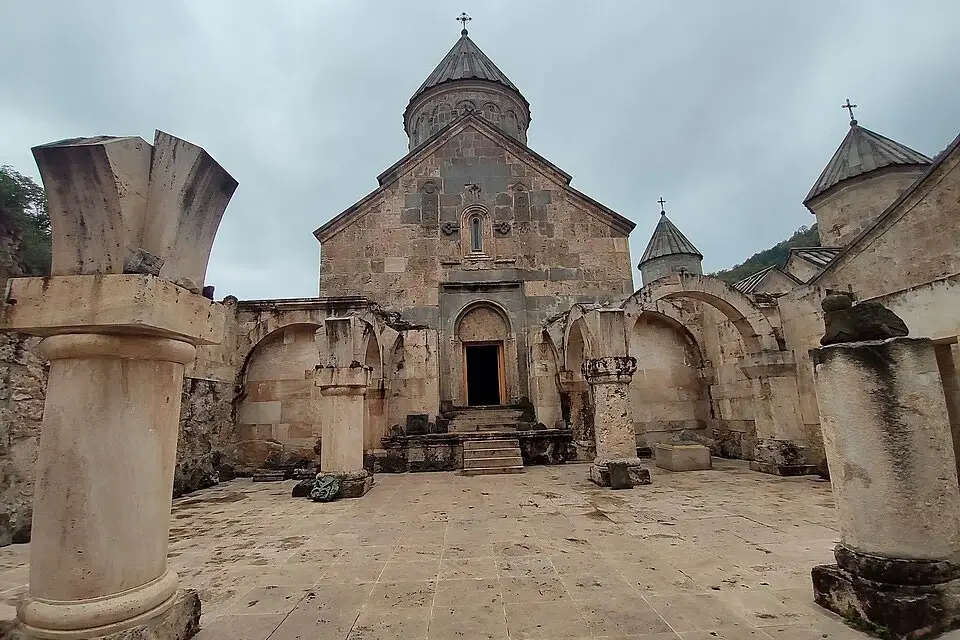
The largest and most ornate church at Haghartsin, built in 1281 in the classic cross-domed plan with two-storey side chambers. The drum carries a sixteen-faced dome decorated with a band of arches, designed to make the dome read as visually weightless. Above the eastern entrance, a sculptural relief shows two figures holding a model of the church between them — most likely the donors of the building, with a dove above. The same motif appears on a few other Armenian monasteries (Haghpat, Sanahin, Harich), but the Haghartsin version is one of the best preserved.
Church of St. Gregory — the oldest at the site
The Church of St. Gregory is the oldest standing building at Haghartsin, dating to the late 10th or early 11th century. It is a small cross-domed church built from grey basalt blocks, with fragments of carved ornament — vegetal and geometric motifs typical of early-medieval Armenian decoration — still visible on the altar apse. Right next to it stands the gavit, and below the southern wall a small chapel contains the tombstones of the Kiurikid royal sepulchre.
Gavit (1185)
The gavit — a vaulted hall placed in front of the main church — is one of the most characteristic features of Armenian monastic architecture. Haghartsin’s gavit adjoins the Church of St. Gregory and is built around four heavy internal columns supporting a vault with a central skylight (yerdik). It served as an assembly hall for the monks, a teaching space, and a burial place for noble patrons. The walls preserve 12th–13th-century lapidary inscriptions — a key source on the monastery’s medieval life. According to a local legend, one of the half-columns is hollow and once swung open to hide the monastery’s treasures during invasions.
Refectory (1248) — unique in Armenia
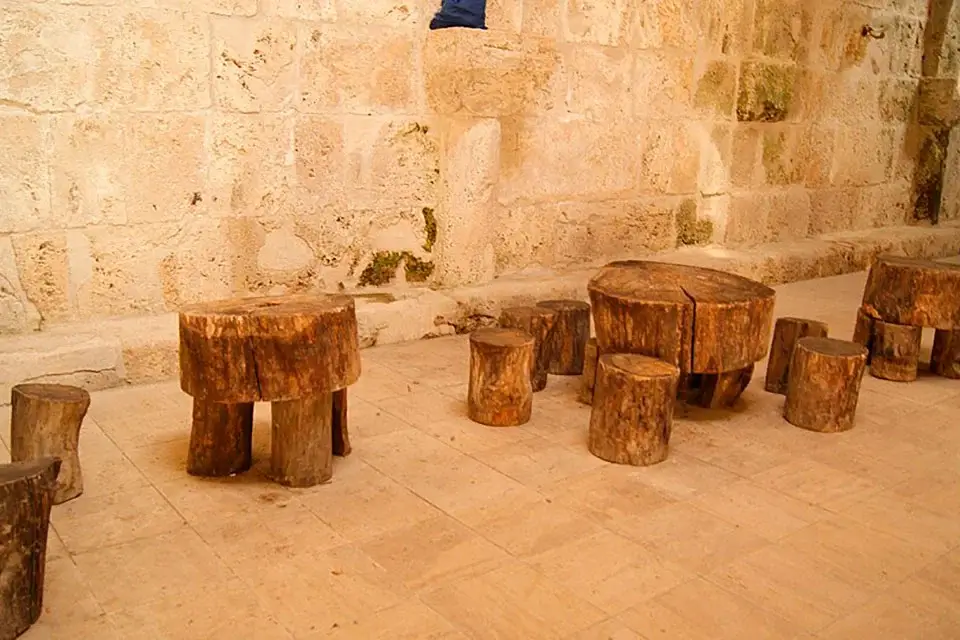
The refectory is the most unusual building at Haghartsin and has no direct parallel in any other Armenian monastery. Built in 1248 by the architect Minas, it is a two-naved hall divided by central pillars that support intersecting arches and ribbed vaults. Light enters through twin skylights in the central bays, decorated with carved trefoils and quatrefoils. Stone benches line the walls. The scale and refinement of the hall point to a large monastic community — at its peak Haghartsin housed an estimated 250 monks, and the refectory functioned both as a dining hall and as a reception space for distinguished guests.
Church of St. Stepanos (1244) and the khachkars
Tucked between St. Gregory and St. Astvatsatsin, the small Church of St. Stepanos was built in 1244. Its decoration is sparing — the effect comes from clean proportions and precise stonework rather than carving. Around the complex, dozens of 12th–13th-century khachkars (cross-stones) survive, several of them built into the walls of the churches and the gavit. Behind the monastery sits a medieval cemetery with the gravestones of noble patrons, and a famous “double-cross” khachkar, said to have been carved by orphans raised at the monastery in the 13th century as a gift to their teach
How to get to Haghartsin Monastery
Haghartsin sits 110 km from Yerevan — about a 1.5–2 hour drive on the M4 highway over the Sevan Pass and through the Dilijan Tunnel, then 18 km from Dilijan along a forested mountain road. There is no public transport directly to the monastery: marshrutka vans from Yerevan’s Northern Bus Station reach Dilijan, from where it is a short taxi ride (around 2,000–5,000 AMD return).
The most comfortable option is to hire a car with driver in Yerevan and combine Haghartsin with Goshavank Monastery and Lake Parz in a single day. The final 5 km of road is a paved forest serpentine; in winter, ice on the bends is possible.
Hours and admission
The monastery grounds are open daily, 8:00–20:00, and admission is free. Sunday liturgy starts at 11:00. A relaxed visit takes 40–60 minutes; with a walk through the forest clearing and photos, around 1.5 hours. There is a parking lot at the entrance, a small bakery selling the local Haghartsin gata (sweet bread filled with apricot and thyme), and a drinking-water fountain at the far end of the grounds.
Practical tips for visiting
The two-naved refectory is the one detail visitors most often miss — it sits slightly apart from the main churches, so make a point of walking around to it. The donor relief above the eastern portal of St. Astvatsatsin rewards a slow look, and several khachkars are set directly into the walls of the gavit. Early autumn (mid-September to mid-October) is the best season for photography: the beech and oak forest around the monastery turns red and gold, and weekday mornings are the quietest. Sunday daytime is busy with weddings — Haghartsin is a popular venue. For a longer trip, a classic day from Yerevan runs Lake Sevan → Dilijan → Haghartsin → Goshavank → Lake Parz.
What else to see nearby
- Goshavank Monastery (~20 km) — a 13th-century complex with one of the finest khachkars in Armenia, carved by the master Poghos in 1291. Founded by Mkhitar Gosh, author of the first Armenian legal code.
- Lake Parz (~10 km) — a small, clear forest lake inside Dilijan National Park, with zipline, rowboats, and walking trails.
- Dilijan (~18 km) — the “Armenian Switzerland”: a resort town with the restored Sharambeyan Street craft quarter and the UWC Dilijan international school campus.
- Matosavank Monastery (~4 km on foot from Haghartsin) — the ruins of a 13th-century monastery hidden deep in the forest, reachable only by trail.
- Jukhtak Vank (~15 km, near Dilijan) — the “Twin Monastery” with two small 12th–13th-century churches in the forest on the edge of town.
FAQ
Haghartsin is the kind of place where medieval Armenian architecture is inseparable from the forest it sits in. Beech and oak ranges, mountain air, and almost complete silence make the 10th–13th-century stonework feel less like a museum than a living space. For more sites across the country, see our guide to things to do in Armenia.


