Noravank Monastery
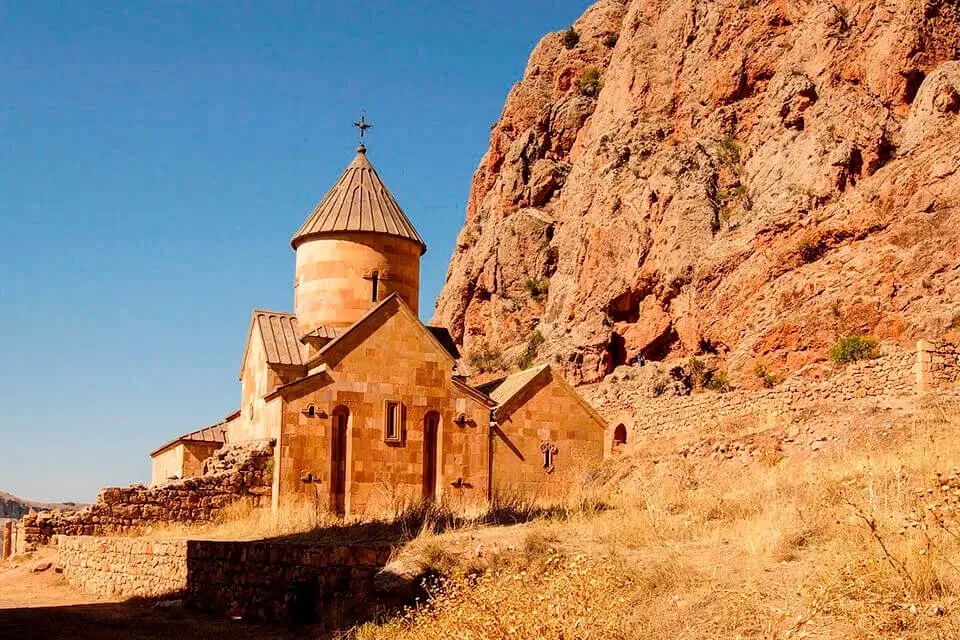
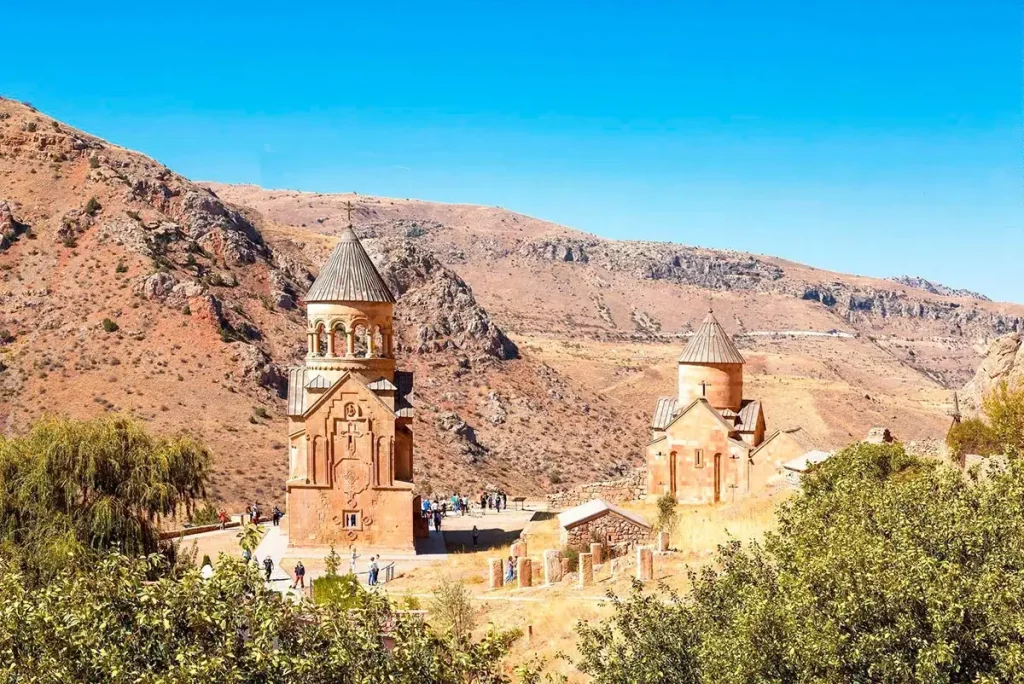
Noravank Monastery is one of the most striking monastic complexes in Armenia — a 13th–14th century medieval masterpiece set in a narrow gorge of brick-red limestone cliffs in the southern province of Vayots Dzor. The name itself means “new monastery” in Armenian, dating to its founding by Bishop Hovhannes in 1105. Over the next two centuries, under the patronage of the powerful Orbelian princes and the genius of the sculptor-architect Momik, Noravank grew into a major spiritual, educational and artistic centre. Today it is best known for its two-story Surb Astvatsatsin Church with narrow exterior stairs, its intricate stone carvings, and the dramatic red-cliff landscape that turns gold at sunset. Located about 120 km south of Yerevan, Noravank is almost always visited together with Khor Virap and the Areni wine region as a full-day trip.
Quick Facts
- Built / Founded: 1105 AD (main complex 13th–14th century)
- Location: Amaghu Valley, Vayots Dzor Province
- Also known as: Noravank, Noravank of Amaghu, New Monastery, Red Monastery, Նորավանք
- From Yerevan: About 120 km / 2 hours
- Entrance fee: Free entrance
- Time needed: 1–1.5 hours
- Best time to visit: Late afternoon for the red cliffs glow; April–June and September–October
- Status: Medieval Armenian monastic complex; restored historical monument
- GPS coordinates:
39.684061, 45.232872
The Red Cliffs of Vayots Dzor
The approach to Noravank is half the experience. From the M2 highway near Areni, a winding road climbs into the Amaghu Gorge (also called Gnishik Canyon) — a narrow valley between sheer cliffs of brick-red limestone, sometimes 200 metres high. After a few kilometres of switchbacks, the gorge opens and Noravank appears: a small group of stone buildings, the same colour as the cliffs, set on a natural shelf in the middle of the landscape.
The red colour of the cliffs comes from iron oxide in the limestone, deposited over millions of years. Locals sometimes call the monastery the “Red Monastery” because of how it blends into the rock face. The light shifts dramatically through the day — pale rose at midday, deep brick-red in late afternoon, almost glowing at sunset.
The surrounding canyon is also part of a protected area with caves (including the Areni-1 Cave further down the valley — site of the world’s oldest known winery, dated to around 4,100 BC) and rich biodiversity. The drive itself is one of the most scenic in Armenia.
History — From the Orbelian Dynasty to the 1840 Earthquake
The first monastery on the site was established in 1105 by Bishop Hovhannes. Our main source for this is the medieval Armenian historian Stepanos Orbelian, who wrote his History of the Province of Syunik at Noravank itself.
The monastery rose to prominence in the 13th century when the Orbelian princes — one of the most powerful noble families in medieval Armenia — adopted Noravank as their dynastic seat and burial ground. Under their patronage Noravank became:
- A residence of the bishops of Syunik.
- A major scriptorium and manuscript-illumination centre, closely linked to nearby Gladzor University and to Tatev Monastery further south.
- The home of the Upper Noravank School, led by Davit Rabunapet, which trained generations of theologians and manuscript artists.
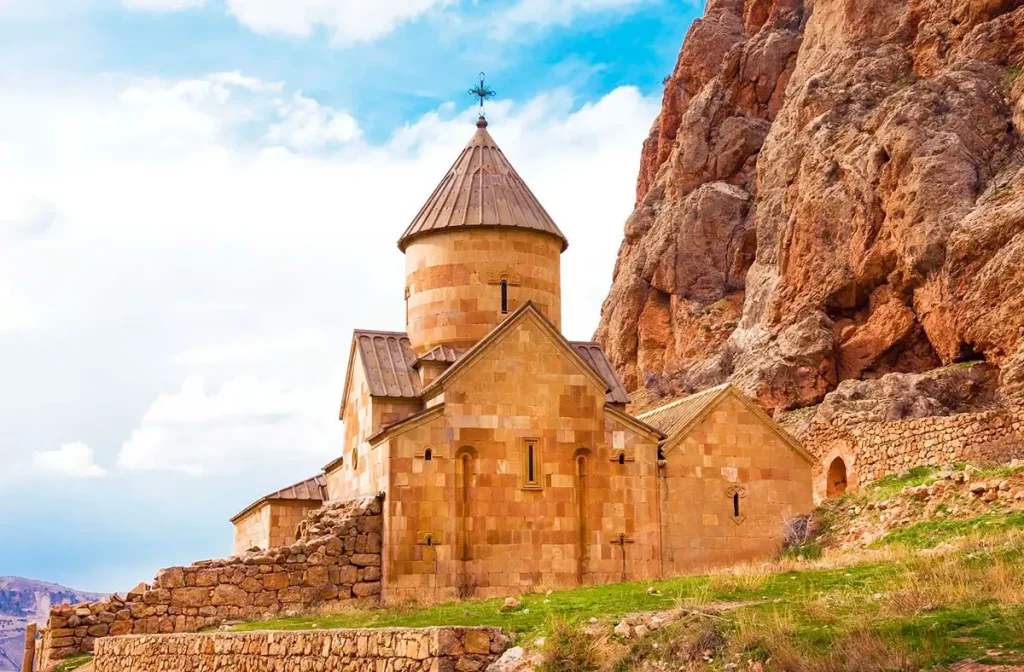
The 13th and 14th centuries were Noravank’s golden age. The main church of Surb Karapet (Holy Forerunner) was completed between 1216 and 1227, the cross-shaped Burtelashen Church was added in the 1330s, and the two-story Surb Astvatsatsin Church was finished by Momik in 1339.
The complex suffered during the Timurid invasions at the end of the 14th century and was repeatedly damaged by earthquakes. A massive earthquake in 1840 caused serious damage and led to the monastery’s abandonment. Major restoration work in the 20th century brought Noravank back to its present state — one of the most carefully reconstructed medieval sites in Armenia.
Architecture — Momik and the Two-Story Church
Noravank is associated above all with Momik (c. 1260–1333), one of the most original figures in medieval Armenian art. Momik was simultaneously an architect, a sculptor, a manuscript illuminator and a khachkar carver. His signature works are found across Vayots Dzor, but Noravank is where his vision comes together most completely.
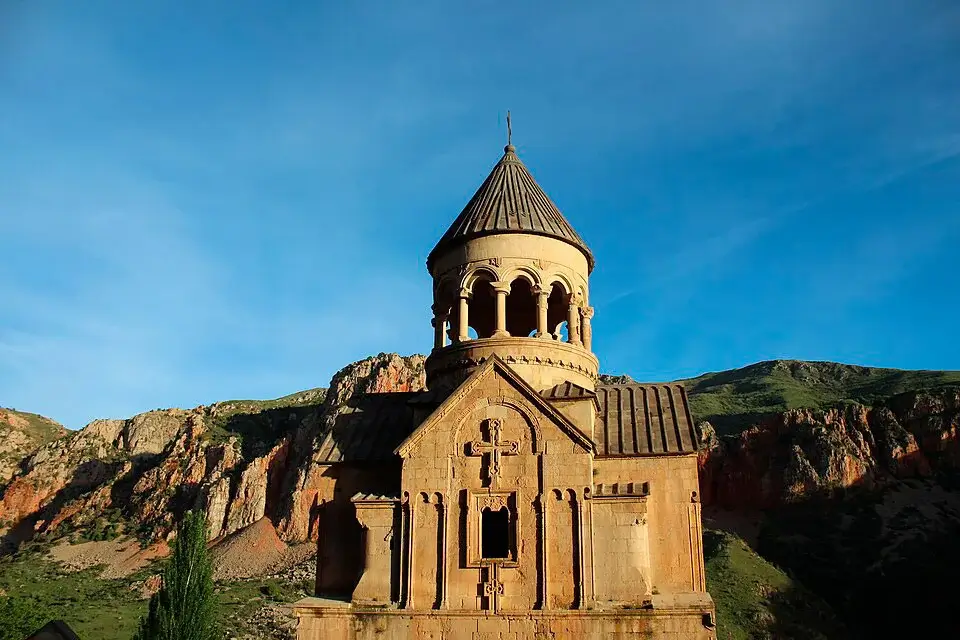
His masterpiece is the Surb Astvatsatsin Church (also called Burtelashen, “built by Burtel” — after the Orbelian prince who commissioned it). Completed in 1339, just before Momik’s death, it is one of the most unusual churches in Armenia:
- Two stories. The lower floor was a mausoleum-chapel; the upper floor was the main worship space.
- Exterior staircases. Two narrow stone staircases climb the western facade — without railings, with only the slimmest projecting steps. The climb is doable in dry weather, but vertigo-inducing. Climb at your own discretion.
- Carved tympanum. Above the entrance is one of the most discussed reliefs in Armenian art: a figure of God the Father holding the head of Adam in one hand and a dove in the other — an iconographic detail that is rare in Eastern Christian art and has been interpreted in many ways by art historians.
Beyond the main church, the complex also includes Surb Karapet (the larger 13th-century church), its gavit (narthex, 1261), the small St. Gregory chapel, and a field of intricately carved khachkars — cross-stones — including several attributed to Momik himself. A khachkar bearing Momik’s name marks the spot where, according to legend, the architect was buried.
The Legend of Momik
A popular Armenian legend tells the story behind Momik’s death — though it is not historically documented. According to the tradition, Momik fell in love with the daughter of an Orbelian prince. The prince agreed to the marriage on one condition: Momik must build a magnificent new church in record time. As the church neared completion, the prince — unwilling to give his daughter to a commoner — sent a mercenary to push Momik from the dome. Momik fell to his death and was buried at the foot of the church he had built, beneath a khachkar he had carved for himself years earlier.
It is a legend, not history. But standing at the foot of Surb Astvatsatsin, looking up at the narrow staircases and the carved figure of God above the door, it is hard not to feel its weight.
How to Get to Noravank from Yerevan
Noravank is about 120 km south of Yerevan in Vayots Dzor Province. The drive takes around 2 hours on the M2 highway, plus a final 8 km off the highway into the Amaghu Gorge.
By private car with driver. The most flexible option, especially because Noravank is usually combined with Khor Virap and Areni in a single long day from Yerevan (8–9 hours total). We provide private cars and drivers in Yerevan for the full southern route at your own pace.
By taxi. A round-trip from Yerevan with waiting time costs roughly 18,000–25,000 AMD for Noravank alone, or 30,000–50,000 AMD for the full Khor Virap + Areni + Noravank loop.
By marshrutka. There is no direct public transport. Shared minibuses from Yerevan run to Yeghegnadzor (about 15 km from Noravank); from there, a local taxi covers the last stretch up the gorge for around 3,000–4,000 AMD. The schedule back is limited, so plan carefully.
By organised tour. Group day tours from Yerevan to Khor Virap + Areni + Noravank are widely available and the most affordable shared option.
Combining with Khor Virap and Areni
The standard southern day trip from Yerevan is Khor Virap → Areni → Noravank, in that geographic order.
- Khor Virap — first stop, about 45 km from Yerevan, with the best view of Mount Ararat in Armenia.
- Areni Wine Region — the village of Areni and its surrounding wineries, famous for the indigenous Areni Noir grape and the Areni-1 Cave, where the world’s oldest known winery (~4,100 BC) was discovered in 2007. Several cave wineries and family-run cellars offer tastings.
- Noravank — the dramatic final stop, ideally timed for late afternoon so the cliffs glow at sunset.
The full loop takes 8–9 hours including driving, stops, lunch and a wine tasting. It is one of the most varied and rewarding day trips in Armenia: pilgrimage history, archaeology, food, wine and a stunning canyon landscape in a single day.
Practical Tips and Best Time to Visit
- Opening hours: the monastery grounds are open daily, generally 09:00–19:00 in summer, shorter in winter. The churches are accessible during the same hours.
- Entrance fee: free. No charge to enter the complex or the churches.
- Parking: small free or token-fee parking area at the foot of the complex.
- Time needed: about 1 to 1.5 hours on site.
- Best time of day: late afternoon, ideally one hour before sunset, when the red cliffs and limestone walls glow. Mornings are calmer but the light is flatter.
- Best season: April–June and September–October. Summer afternoons can be very hot in the gorge; winter visits are dramatic but the access road is occasionally icy.
- Dress code: modest dress required for the churches — cover shoulders and knees. The site is active and pilgrims still visit.
- The two-story stairs: climbing the narrow exterior staircase of Surb Astvatsatsin is permitted, but there are no railings and the steps are shallow. Skip if you have vertigo or any mobility limitation. The view from the upper floor is impressive but not essential.
- Facilities: small café and souvenir stand near the parking area; basic restrooms.
FAQ
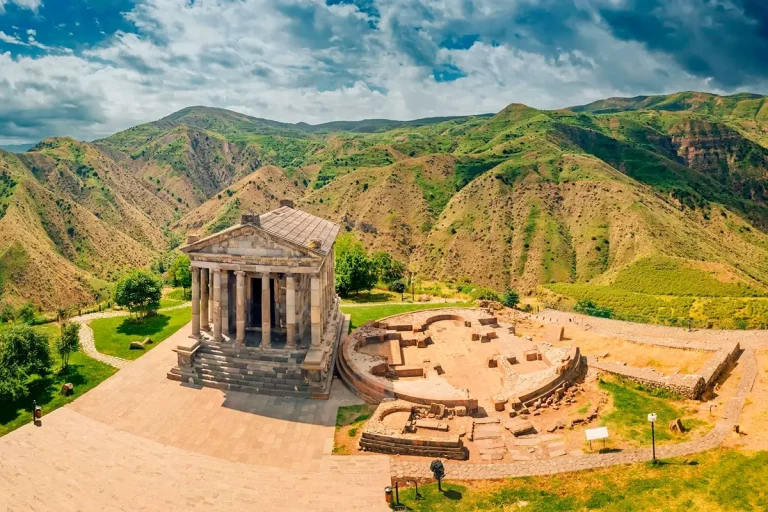
See more places in our full guide to things to do in Armenia — including Khor Virap, Garni Temple, Geghard Monastery, Lake Sevan and other top day trips from Yerevan.