Garni Temple
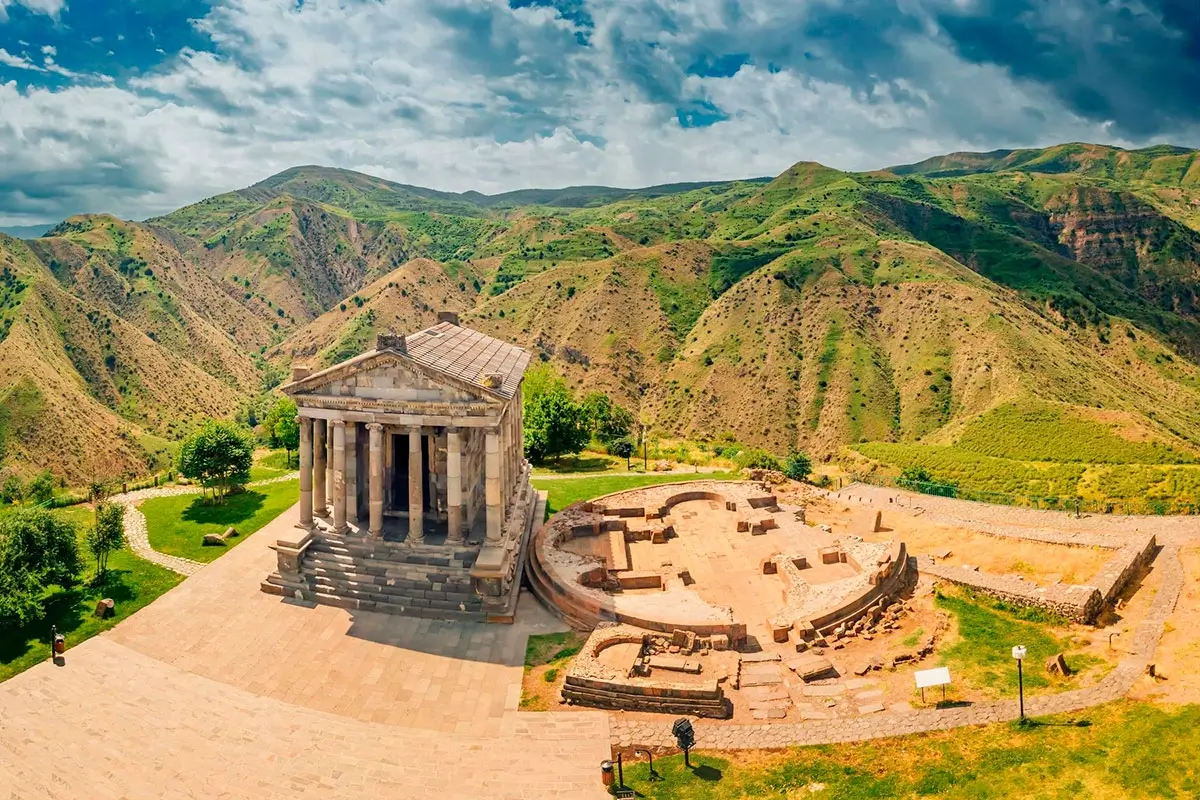
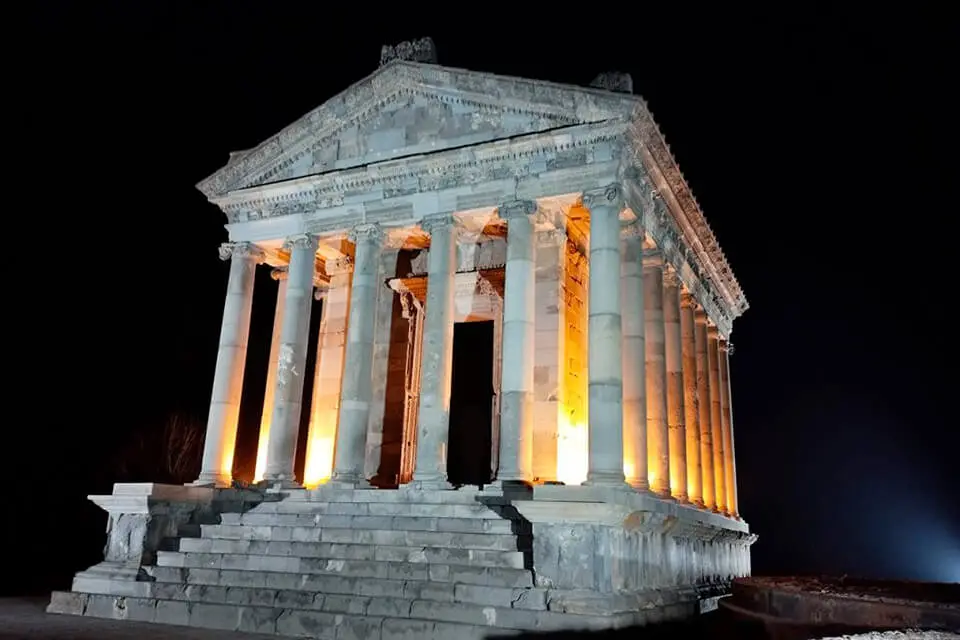
Garni Temple is the only fully preserved Greco-Roman building in Armenia and one of the most photographed sites in the country. Standing on a triangular basalt cliff above the Azat River gorge, it dates back to the 1st century AD and is the last surviving pagan temple from pre-Christian Armenia. The temple is part of a larger archaeological complex that includes Roman baths with a mosaic floor, the remains of a royal summer residence, and ruins of a 7th-century church — all reachable on an easy half-day trip from Yerevan.
Quick Facts
- Built / Founded: 1st century AD
- Location: Garni village, Kotayk Province
- Also known as: Temple of Garni, Garni Pagan Temple, Temple of Mihr
- From Yerevan: About 30 km / 40 minutes
- Entrance fee: 1500 AMD for foreign visitors
- Time needed: 1–1.5 hours
- Best time to visit: Spring, autumn and early morning in summer
- Status: Historical and cultural monument
- GPS coordinates:
40.112421, 44.730277
History of Garni Temple
The temple is traditionally dated to 77 AD, during the reign of Armenian King Trdates I. After being crowned in Rome by Emperor Nero, Tiridates returned with funding and craftsmen, who helped build the temple in Hellenistic style. It was dedicated to Mihr, the Armenian sun god, equivalent to the Persian Mithra.
When Armenia adopted Christianity as its state religion in 301 AD — the first country in the world to do so — almost all pagan temples were systematically destroyed. Garni was the only major exception. One widely cited explanation is that the temple was preserved as a royal summer residence by the intercession of Princess Khosrovidukht, sister of Tiridates III. An alternative scholarly view, supported by historian Robert H. Hewsen, holds that the structure was not a temple at all but a royal tomb, which would also explain its survival.
The temple stood for over fifteen centuries before being toppled by a devastating earthquake in 1679. Most of the original blocks remained on site, scattered around the foundation, which made later reconstruction possible.
Architecture and the 1969–1975 Reconstruction
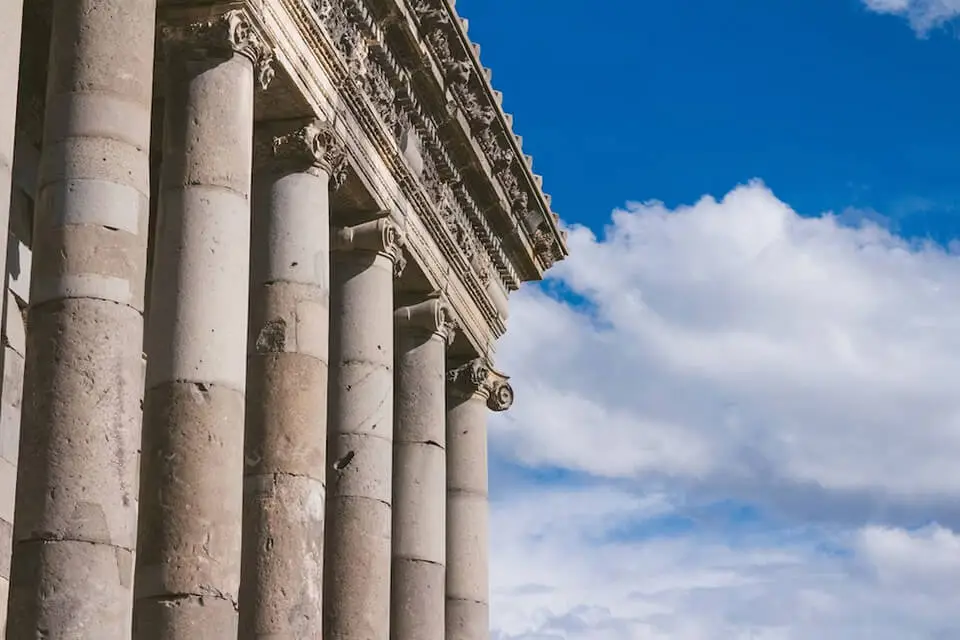
Garni is built in the Ionic order, with 24 columns surrounding a small inner sanctuary. It measures 15.7 by 11.5 metres and stands about 10.7 metres tall. The entire structure is made of local basalt, a dark volcanic stone that gives it a distinctive heavy appearance compared to the white marble of Greek or Roman originals.
The reconstruction was carried out between 1969 and 1975 by Armenian architect Alexander Sahinian, using the technique of anastylosis — re-erecting the building from its original fallen blocks, with replacement stone used only where pieces were missing or too damaged. The result is one of the most authentic Hellenistic-style reconstructions in the region. New stone is left rougher and lighter than the original blocks, so visitors can easily see which parts are ancient and which are modern.
The Garni Archaeological Site — What Else to See
Most visitors come for the temple itself, but the surrounding complex is worth at least another half hour:
- Roman bathhouse with a partially preserved mosaic floor, dating to the 3rd century AD. The mosaic includes a Greek inscription that translates roughly as “We worked without receiving anything” — a rare and somewhat enigmatic note left by ancient craftsmen.
- Royal summer palace ruins, identified from the foundations on the southwest side of the plateau.
- Sion Church ruins from the 7th century, built after Armenia’s conversion to Christianity.
- Fortress walls dating back to Urartian times (8th–6th centuries BC) — the cliff was already fortified long before the temple was built.
The viewpoint from the temple terrace over the Garni gorge is one of the best in the Yerevan area.
How to Get to Garni from Yerevan
Garni village is about 28–30 km east of Yerevan. There are three practical options.
By marshrutka (shared minibus). Buses 266 and 284 depart from Gai Bus Station (Nor Nork district, 14/3 Gai Avenue, next to the Mercedes-Benz dealership). The ride costs around 300 AMD and takes 40–50 minutes. The bus stops in Garni village; from there it is a 5-minute walk to the temple entrance. Marshrutkas leave roughly every 30–60 minutes when full, and the schedule back to Yerevan is limited — the last reliable departure is usually mid-afternoon.
By taxi. A one-way taxi from central Yerevan costs roughly 4,000–6,000 AMD. Apps like GG and Yandex Go work in Yerevan.
By private car with driver. The most flexible option, especially if you also want to visit Geghard Monastery and the Symphony of Stones the same day. We provide private cars and drivers in Yerevan for day trips, with stops at your own pace.
Opening Hours, Entrance Fee and Practical Tips
- Opening hours: daily 10:00–20:00. Summer hours are sometimes extended to 21:00 or 22:00; winter hours may close earlier, around 17:00. Hours are subject to change — always good to confirm before a late-afternoon visit.
- Entrance fee: 1,500 AMD for foreign visitors, 750 AMD for Armenian citizens (as of 2025–2026).
- Parking: small lot near the entrance, 100 AMD. Can get crowded in summer; parking along the road and walking down is often easier.
- Time needed: 45–60 minutes for the temple and complex.
- Facilities: restrooms, small café, souvenir stalls near the entrance.
- What to wear: comfortable walking shoes — the temple platform and bath area have uneven stone surfaces. Bring a hat and sunglasses in summer; the plateau is exposed.
What to See Near Garni Temple
Symphony of Stones is the most popular natural sight near Garni Temple. It is located in Garni Gorge, below the temple plateau, where the Azat River has exposed tall basalt columns that look like a natural stone organ. Many visitors add this stop to the same trip because it is only a short drive from the temple and gives a completely different view of the Garni area.
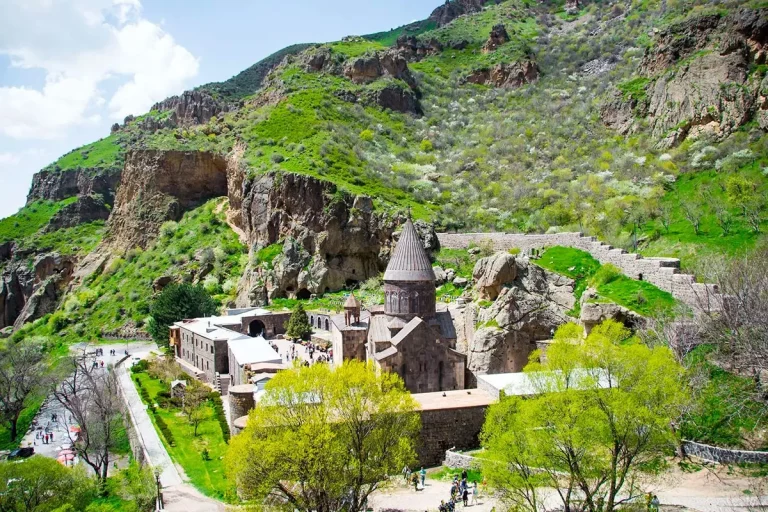
Geghard Monastery is usually combined with Garni Temple in one half-day trip from Yerevan. The monastery is located further along the same route, about 10 km from Garni, in a narrow mountain valley surrounded by cliffs. This combination is one of the classic routes in Armenia: a pagan temple, a Christian monastery, mountain scenery and a short drive from the capital.
Garni Gorge is worth seeing even if you do not go all the way down to the basalt columns. The temple stands on the edge of the gorge, and the viewpoints around the complex open wide views over the Azat River valley. The gorge is especially beautiful in clear weather, when the contrast between the dark basalt cliffs, green slopes and the temple platform is easy to see.
Garni and Geghard Day Trip from Yerevan
Garni Temple is most often visited as part of a classic Garni and Geghard day trip from Yerevan with the Symphony of Stones. This route usually includes Garni Temple, Geghard Monastery and the basalt columns in Garni Gorge, with enough time to see both the historical monuments and the natural landscape around the Azat River valley.
The drive from Yerevan to Garni takes about 40 minutes, and Geghard Monastery is located further along the same road. The Symphony of Stones can be added as a short detour into the gorge, making the route more complete and visually impressive. Most travelers need around 5–6 hours for the full trip, including stops, photos and a relaxed visit to each place.
This route is especially convenient by private car with driver, because public transport is limited and does not easily cover all three places in one comfortable itinerary. With a private trip, you can visit Garni, Geghard and the Symphony of Stones at your own pace and return to Yerevan the same day.